RAG Data Flow (Canonical)
Canonical decomposition of the retrieval + generation pipeline. Supersedes monolithic legacy page ../rag_pipeline.md.
Intent + profile (+ optional trip context) → cache lookup → hybrid retrieval → conditional enrichment → context assembly → LLM generation → attribution & compliance → cache store → client delivery.
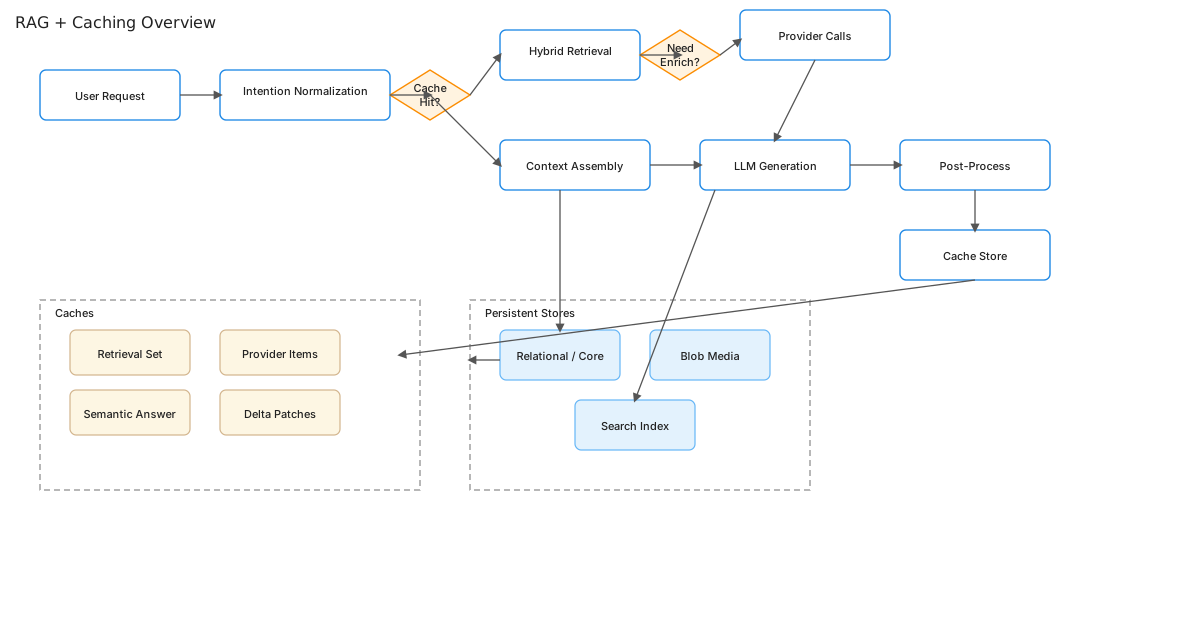
Figure: High-level RAG + caching overview. Blue = processing stages, gold = decisions, tan = caches, teal = persistent stores.
1. Hashing & Cache Keys
Each cache key uses a stable 64-bit FNV or Murmur hash of a canonical JSON subset. Version suffixes bump when prompt or template semantics change.
Cache entries: - Retrieval set (petal IDs + metadata snapshot) - Generated answer (trip draft or recommendation set)
Eviction / TTL (initial): - Retrieval: 30–120 min (volatile sources shorter) - Generation: 10–30 min unless user-saved
2. Retrieval Strategy
Primary: Azure Cognitive Search hybrid (BM25 + vector). Server-side filters: geo radius, tags, seasonality, accessibility.
Diversification heuristic: if top 8 share >60% identical tag set, replace lowest 2 with high-distance related_petals to enhance thematic variety.
Ranking blend (heuristic v1):
score = 0.55 * vector_score + 0.35 * bm25 + 0.10 * recency_decay
Future: learned-to-rank on interaction feedback.
Failure handling: - Empty result → broaden filters once (geo widen, relax tag strictness) - API timeout → fallback to cached retrieval (<1h old)
3. External Enrichment Decision Matrix
Trigger enrichment only if:
- Missing critical fields (opening_hours, pricing_tier)
- last_updated stale (>7d events, >30d attractions)
- License flag requires refreshed attribution
Controls: token bucket per provider; circuit breaker after consecutive failures.
4. Context Assembly Templates
Blocks: 1. User preference summary 2. Trip scaffold (dates, companions, constraints) 3. Petal snippets (top N grouped by thematic cluster) 4. Preference summary (favorite tags, companions, travel modes) 5. Safety / license directives
Budget: target < 6k input tokens (reserve generation headroom).
5. Prompt Strategy & Safety Filters
Sections: - System (role & compliance constraints) - Context (assembled blocks) - Instruction (output format JSON itinerary or bullet recommendations)
Safety: - Regex/policy filter post-generation - Mandatory attribution enforcement before return
6. Response Post-Processing & Attribution
Steps: 1. Parse JSON (repair prompt retry if invalid) 2. Attach source & license metadata per petal 3. Insert AI generation disclaimers 4. Compute quality score (coverage, diversity, personalization alignment)
7. Metrics & Observability
| Metric | Target (MVP) | Notes |
|---|---|---|
| P95 end-to-end latency | < 1200 ms | Warm cache path ~500–700 ms |
| Cache hit ratio (retrieval) | > 55% | Cost efficiency lever |
| Generation token cost / req | < $0.25 | Track per intent type |
| Invalid JSON rate | < 3% | Trigger prompt revision above |
| Enrichment call success | > 98% | After retries |
| Diversification applied rate | 10–25% | Healthy exploration range |
Tracing: correlate intent_id across classification → retrieval → generation.
8. Future Optimizations
- Learned re-ranking model
- Multi-vector field indexing
- Adaptive cache TTL (volatility score)
- Structured function calling for JSON validation
- Distillation for cheaper re-ranker
- Daily preference embedding refresh
Last updated: September 2025